



Making the right execution choice can save your project time, money, and unnecessary complexity.
In India’s fast-moving construction ecosystem—especially in the industrial and infrastructure sectors—the way a project is executed can significantly impact its success. While most companies are familiar with the traditional construction execution model, turnkey contracting has emerged as a powerful alternative in recent years.
At Creativve Constructiions, we’ve delivered projects using both approaches. But when we look back at outcomes—budget control, timelines, communication, and client experience—the difference lies in execution philosophy.
This blog breaks down the difference between Turnkey Contracting and Traditional Execution, helping you decide which model is better suited for your next project.
What is Traditional Execution?
In traditional construction, you may be mThis is the most common model in India. The client appoints different entities for each scope:anaging:
- Architects for planning and design
- Structural consultants for engineering
- Quantity surveyors for estimation
- Multiple contractors for execution
- Vendors for materials and procurement
The client (or their project management team) acts as the overall coordinator.
Pros:
- More flexibility in contractor and vendor selection
- Higher control for technically savvy clients
- Can work well for projects that evolve in phases
Cons:
- High dependency on internal coordination
- Finger-pointing during disputes
- Delays due to sequential workflows and unclear responsibilities
- Budget escalation due to rework or poor design-execution alignment

In a Turnkey or EPC (Engineering, Procurement, and Construction) model, a single company takes full ownership of the entire project. From design and planning to construction, handover, and compliance—the client deals with one partner.
The name comes from the idea that the client should simply “turn the key” to their completed facility—without daily involvement in technical coordination.
Pros:
- One point of accountability
- Faster project cycles due to concurrent processes
- Budget, design, and execution are integrated
- Ideal for time-sensitive or technically demanding projects
Cons:
- Requires a trustworthy and experienced turnkey partner
- Less flexibility to change design mid-project
- May seem costlier upfront—but often cheaper overall due to efficiency
| Feature | Traditional Execution | Turnkey Contracting |
|---|---|---|
| Vendors | Multiple (client managed) | Single entity manages all |
| Responsibility | Divided among consultants and contractors | One company owns it end-to-end |
| Speed | Slower due to handovers | Faster due to parallel execution |
| Cost Control | Risk of overruns | Tighter due to early-stage planning |
| Client Role | Deep involvement needed | Minimal—strategic decisions only |
| Communication | Fragmented across vendors | Centralized with one SPOC |
When Should You Choose Turnkey?
Turnkey is ideal when:
- You need faster delivery with minimal hassle
- You’re working on a factory, warehouse, or expansion where every day of delay affects your operations
- You want to avoid design-execution disconnects
- You’re not technically equipped to coordinate multiple vendors
- You value certainty and clarity over day-to-day micro-control
Common Turnkey Use Cases in India
- Industrial production units
- Pharma facilities (where compliance and speed matter)
- Logistic parks
- Warehouses
- Commercial interior fit-outs with tight launch deadlines
- Educational or healthcare infrastructure where budgeting is key
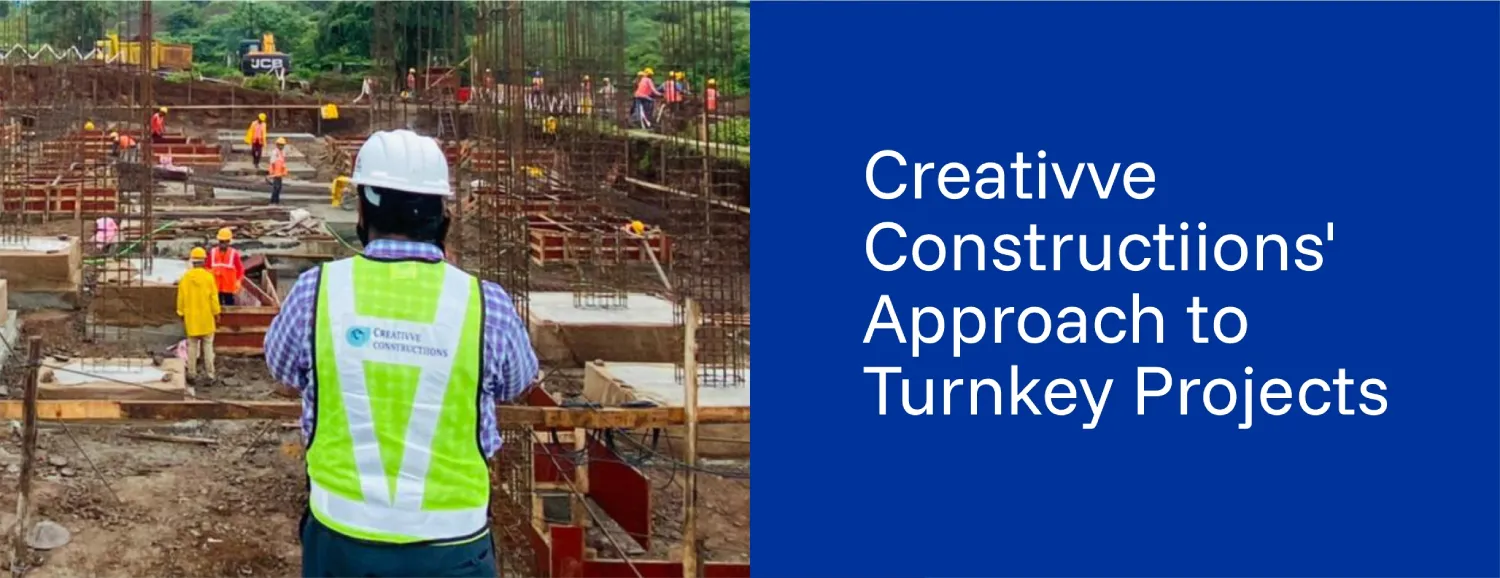
At Creativve Constructiions, our turnkey process ensures every aspect is handled professionally while keeping the client in the loop for major decisions.
Here’s how we approach it:
Step 1: Requirement Mapping
We sit with the client to understand operational needs, space usage, future expansion plans, and regulatory requirements.
Step 2: Design & Planning
Our in-house design team collaborates with structural and service engineers to deliver a buildable plan—ready for execution and optimization.
Step 3: Budget Estimation & Resource Planning
We provide clear BOQs, procurement strategies, and milestone-linked payment structures.
Step 4: Execution & Supervision
From foundation to finishing, our site teams and vendors work under one command chain. Weekly updates are shared, and site decisions are taken swiftly.
Step 5: Final Handover & Compliance Support
We assist in final checks, safety audits, and handover documentation. Our team remains available for defect resolution and AMC, if required.
Client Perspective: Why They Prefer Turnkey
“We didn’t have to spend hours managing different consultants. Everything was streamlined. Even our energy approvals and firefighting layouts were managed under one roof. That peace of mind was worth it.”
— Industrial client, Pune
“Earlier, our internal team would get stuck between vendors. With Creativve’s turnkey system, we had one contact, one team, and everything moved much faster.”
— Project Head, Manufacturing MNC
Cost vs Value: The Misconception
Many clients initially believe Turnkey = Expensive. But let’s break that myth:
- Traditional Hidden Costs:
- Rework due to miscommunication
- Idle site costs due to vendor delays
- Design revisions not budgeted
- Client team time spent in firefighting
Turnkey Value Add:
- Reduced rework
- Predictable delivery
- Lower internal manpower load
- Seamless experience
📊 Studies show that properly executed turnkey projects result in up to 15–20% cost efficiency when total lifecycle cost is considered.
Still Unsure Which to Choose? Ask Yourself:
- Do I want tighter control, or smoother coordination?
- Do I have a team that can manage multiple vendors?
- Can I afford delays due to misalignment?
- Am I willing to trade a little flexibility for speed and clarity?
Your answers will guide your model selection.
Conclusion: The Future is Integrated
As India moves towards faster infrastructure growth, EPC and Turnkey contracting are becoming the preferred route for companies that want speed without stress.
Whether you’re constructing a factory, setting up a new division, or expanding your operations—choosing the right execution model is half the battle.
And if that battle feels too fragmented—turnkey may be your answer.